Introduction: From Burden to Business Opportunity
For decades, sustainability has been seen as a cost center — something companies must do to meet regulations or maintain public trust. But in today’s evolving global economy, sustainability is fast becoming a profit driver, especially in the maritime and logistics sectors.
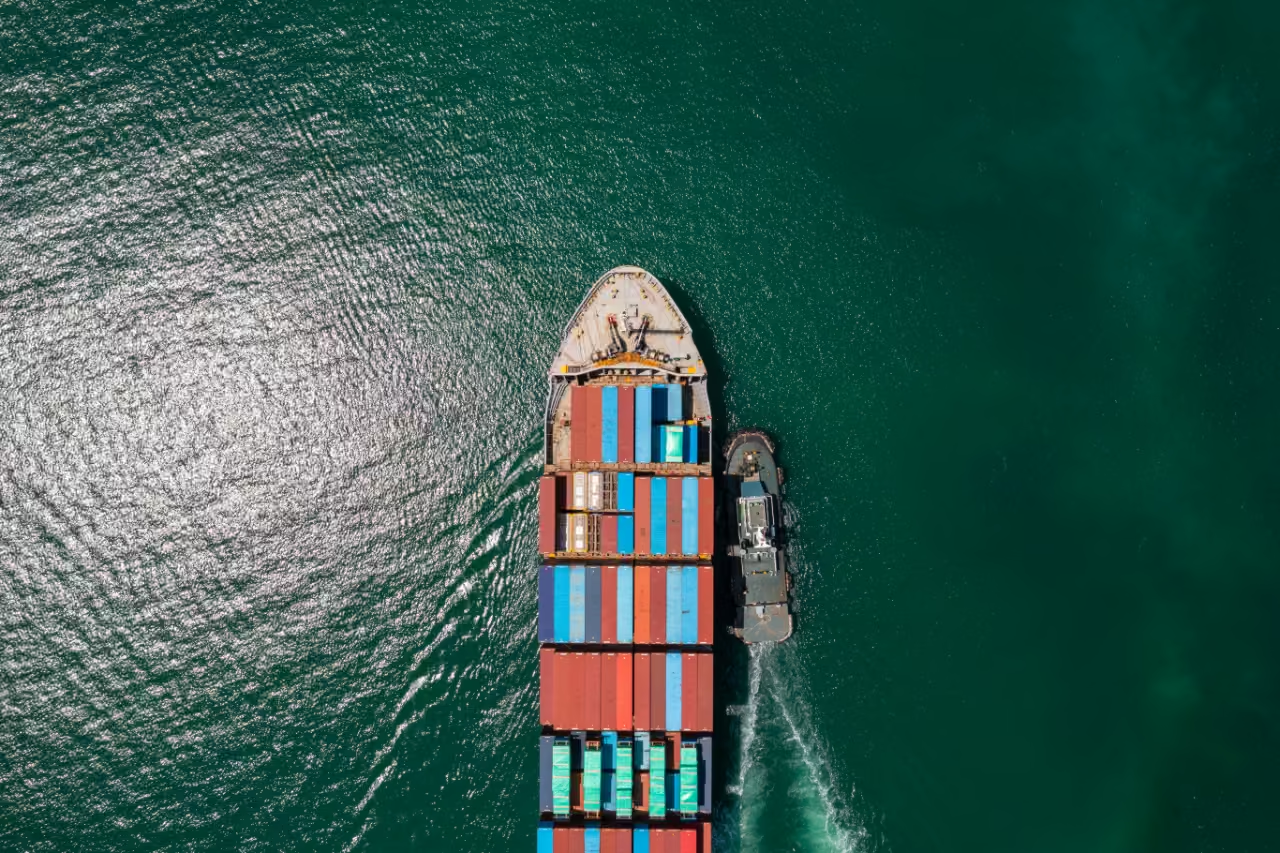
The shipping industry, responsible for about 3% of global greenhouse gas emissions, is now under growing pressure from the International Maritime Organization (IMO) and regional frameworks like the EU Emissions Trading System (EU ETS) to curb its carbon footprint.
Yet, what many shipping operators, exporters, and logistics companies are discovering is this:
Compliance with carbon rules isn’t just a defensive move — it’s a strategic financial opportunity.
Through carbon offsets, credits, and verified emissions data, companies can turn sustainability from a regulatory burden into a revenue-generating asset class.
This is where innovative platforms like EcoShip Ledger are changing the game.
1. Understanding Carbon Offsets and Credits
What Are Carbon Offsets?
A carbon offset represents a measurable reduction in greenhouse gas (GHG) emissions. Companies can purchase these offsets to compensate for the emissions they produce, effectively “balancing” their carbon footprint.
Offsets are usually generated through environmental projects such as:
- Reforestation or forest conservation
- Renewable energy installations (solar, wind, hydro)
- Carbon capture or clean fuel technology
- Methane reduction in agriculture or waste systems
Each project must meet strict verification standards, such as Verra (VCS), Gold Standard, or CDM (Clean Development Mechanism).
Carbon Credits vs. Offsets
While “carbon credit” and “carbon offset” are often used interchangeably, there’s a technical distinction:
- Carbon Credit: Represents a tradable certificate (usually 1 ton of CO₂ equivalent).
- Carbon Offset: Refers to the act of compensating emissions through these credits.
So, when companies buy or sell carbon credits, they’re effectively participating in a carbon offset market.
2. Why Carbon Offsets Matter in the Shipping Industry
Shipping is the lifeblood of global trade, moving over 80% of goods worldwide — and burning millions of tons of fuel annually. Despite progress in clean technologies, many vessels still rely on fossil fuels.
This makes carbon offsets and verified emission tracking crucial for:
- Meeting compliance requirements under IMO’s carbon intensity indicator (CII) and Energy Efficiency Existing Ship Index (EEXI).
- Participating in regional cap-and-trade systems like the EU ETS, which will soon apply to international maritime operations.
- Attracting green investors and sustainability-focused customers.
Offsets allow shipowners and exporters to bridge the gap between current emissions and long-term decarbonization goals.
3. The Global Carbon Market Landscape
Compliance Markets
These are regulated systems where governments cap total emissions and allow trading of emission allowances.
Key examples:
- EU ETS (European Union Emissions Trading System)
- UK ETS
- Korean ETS
- California Cap-and-Trade Program
Shipping companies operating in these regions must buy credits to offset emissions beyond their allocated limits.
Voluntary Carbon Markets (VCMs)
Here, companies offset emissions voluntarily — often to meet ESG targets or appeal to eco-conscious customers.
VCMs are growing rapidly, projected to reach $100 billion by 2030 (McKinsey & Co.).
By engaging early, maritime firms can gain both reputation and financial upside before global demand pushes credit prices higher.
4. Turning Compliance into Profit
A Paradigm Shift
Historically, carbon compliance was about avoiding penalties. Now, it’s about unlocking new value streams.
Forward-thinking companies use carbon management to:
- Monetize excess reductions by selling unused carbon credits.
- Enhance brand equity through verified sustainability credentials.
- Access green financing, such as low-interest sustainability-linked loans.
Example: A Shipping Company’s Profit Pivot
Imagine a fleet operator that installs advanced emission sensors, uses AI route optimization, and cuts fuel consumption by 20%.
Under the EcoShip Ledger system, those verified reductions generate tradeable carbon credits.
Instead of merely reporting compliance, the company can:
- Sell excess credits to other firms in need.
- Reinvest proceeds into cleaner technologies.
- Market their progress to ESG-focused clients.
This transforms sustainability from an obligation into an asset-generating strategy.
5. The Role of Blockchain in Carbon Verification
One of the biggest challenges in carbon trading is trust — ensuring that every credit is real, verified, and not double-counted.
EcoShip Ledger leverages blockchain technology to solve this by:
- Storing emission data on immutable digital ledgers.
- Linking each credit to a unique ID for traceability and verification.
- Ensuring that every ton of CO₂ reduction is transparent and auditable.
This digital trust layer eliminates fraud risks and builds investor confidence in carbon markets.
6. AI and IoT: The New Drivers of Carbon Efficiency
IoT Sensors for Real-Time Tracking
Modern vessels are equipped with IoT sensors that record:
- Fuel type and consumption
- Engine efficiency
- Emissions per nautical mile
EcoShip Ledger aggregates this data into a single digital dashboard, providing both real-time insights and certified emissions records.
AI Route Optimization
Artificial intelligence processes millions of variables — weather conditions, wind patterns, current speeds — to recommend the most fuel-efficient routes.
This leads to:
- Lower fuel costs (up to 15%)
- Reduced emissions
- Verified data that can generate tradable carbon credits
In essence, AI turns operational data into monetizable sustainability insights.
7. How Companies Can Capitalize on Carbon Assets
Step 1: Measure
Collect accurate, verifiable data from IoT devices, fuel logs, and voyage reports.
EcoShip Ledger automates this process and ensures compliance with IMO DCS and MRV standards.
Step 2: Verify
Ensure emission reductions meet global certification criteria through third-party verifiers and blockchain-backed data integrity.
Step 3: Offset
Buy verified carbon credits to cover unavoidable emissions, strengthening your ESG profile.
Step 4: Trade
Sell excess credits or participate in carbon exchanges to generate new revenue.
Step 5: Report
Generate digital reports aligned with ESG frameworks (GRI, SASB) and regulatory filings (EU ETS, IMO) — directly through EcoShip Ledger.
This 5-step framework helps companies move from reactive compliance to active profit generation.
8. Financial and Strategic Benefits
A. Access to Green Capital
Banks and investors are prioritizing ESG-compliant portfolios. Companies with measurable emission reductions qualify for lower-cost capital and sustainability-linked financing.
B. Competitive Differentiation
Customers increasingly prefer shippers and exporters who demonstrate carbon responsibility. Verified sustainability can boost your market share and brand trust.
C. Risk Mitigation
Carbon assets can hedge against future carbon price volatility. Holding verified credits today can protect companies from tomorrow’s higher compliance costs.
D. Profit Diversification
Carbon credits can evolve into a new balance-sheet asset — one that appreciates as carbon prices rise globally.
9. Common Challenges — and How to Overcome Them
| Challenge | Solution |
|---|---|
| Lack of accurate data | Deploy IoT sensors and integrate data into a unified ledger |
| Complex verification process | Use blockchain for transparent, automated verification |
| Limited understanding of carbon markets | Access in-platform education and expert advisory through EcoShip Ledger |
| Fear of regulatory changes | Stay compliant through automatic updates aligned with IMO, EU ETS, and global frameworks |
By digitizing compliance and automating verification, platforms like EcoShip Ledger eliminate barriers to entry for smaller operators and exporters.
10. Real-World Example: A Profitable Sustainability Loop
Let’s consider OceanStar Logistics, a fictional mid-sized shipping company:
- They install IoT-based emission trackers across their fleet.
- Data is verified on EcoShip Ledger’s blockchain.
- AI reduces their route emissions by 18%.
- The reduction equals 10,000 tons of CO₂, generating verified carbon credits.
- OceanStar sells half of those credits on the EcoShip marketplace.
- Proceeds fund the purchase of hybrid-fuel engines, further reducing future emissions.
Within one fiscal year, compliance became a profitable sustainability loop — cutting costs, generating new income, and enhancing investor appeal.
11. The Future of Carbon as a Digital Asset
As sustainability evolves, carbon credits are no longer just compliance tools — they’re becoming financial instruments.
We’re witnessing the rise of “carbon tokenization”, where verified credits are represented as digital assets on blockchain networks.
This innovation allows:
- Instant global trading
- Fractional ownership of carbon assets
- Liquidity in a traditionally illiquid market
Platforms like EcoShip Ledger are at the forefront of this shift — turning emissions data into traceable, tradable, and profitable digital assets.
12. Key Takeaways
- Compliance is the starting point, not the finish line.
- Verified emission reductions have real financial value.
- Blockchain and AI make carbon trading transparent and scalable.
- Carbon assets can diversify revenue streams and attract green investors.
By turning sustainability into a profit center, businesses not only comply with climate rules but lead the new era of smart, responsible shipping.
Conclusion: Profit Meets Purpose
The journey toward decarbonized shipping isn’t just about avoiding penalties or meeting minimum regulatory requirements. It’s about embracing a smarter, more profitable future.
When companies integrate technology, transparency, and trading through platforms like EcoShip Ledger, they don’t just meet global standards — they set them.
Carbon management becomes more than compliance. It becomes an asset — one that delivers value to both the planet and the bottom line.